

On April 22, 2026, the Oshkosh Common Council voted unanimously to rescind its contract with Flock Safety. Less than 24 hours earlier, the same council had voted 5–2 to renew it.
What changed in those 24 hours was not public pressure. The pressure had been there for weeks. What changed was that the Chief of Police publicly confirmed, on the record, that information had come to his department which conflicted with what Flock told the council.
MY OPINION: THE SINGLE MOST IMPORTANT QUESTION TO ASK TO EVERY SINGLE FLOCK REPRESENTATIVE ON THE RECORD
Question: Does the Flock system create a heat map (pattern of life) of a vehicle movement using the multiple aggregated images for a specific searched vehicle?
The vendor was caught misrepresenting its capabilities. The renewal could not survive that.
This document is the receipt and the recipe.
Who is this for?
Residents who have never spoken at a council meeting and want to understand what to actually do.
Organizers who already know how to run a town hall and want the surgical-level tactical playbook for an ALPR fight specifically.
Journalists working a Flock story locally and looking for the documents, contradictions, and questions that produced movement here.
You can read this top to bottom or jump to Part II for the playbook.
PART I — THE NARRATIVE
March 31, 2026 — The Deferral
The Common Council met for roughly seven and a half hours. Approximately three of those hours were spent on Flock. Local press reported that about a dozen residents spoke during public comment, and all of them spoke against the renewal.
The Council voted 4–3 to defer the renewal vote to April 21.
For the delay: Amos (proposed), Stephenson, Buelow, Spanbauer
Against the delay: Mugerauer, Floam, Nichols
The contract under consideration covered 25 to 26 Flock cameras across the city, paying the company $163,500 across two years. The original deployment of 20 cameras dated to 2022, when the council approved the program with little public scrutiny under a state grant funded through Wisconsin’s COVID relief allocation. Six additional cameras were added in 2025.
Of the three council members who voted against the deferral, Floam and Nichols were not running for re-election; their terms expired immediately after this meeting. Both had publicly supported renewal but, by voting to push the decision to April 21, ensured neither would be the one to make it.
The full archived meeting is below. It runs seven and a half hours; the video playback is set to start with Flock. The Flock discussion takes up roughly three hours. Watch the public-comment portion in particular — about a dozen residents stood at the podium, and on the local press's count, every one of them opposed renewal. The 4–3 deferral vote comes at the close.
April 11–18 — The Public Discourse
In the three weeks between the deferral and the renewal vote, the Oshkosh Northwestern’s editorial pages became the public square in which the Flock contract was actually debated. The paper’s own reader callout reported its readership was split down the middle on the question.
April 11 — Former Councilmember DJ Nichols, whose term had ended ten days earlier, published a guest column in the Northwestern titled “Flock cameras need policy and oversight.” Nichols argued for renewal, framing the decision as one that should be grounded in facts rather than national political narratives, and asserting that the cameras could not be used for federal data collection without the city’s knowledge.
April 11–18 — Letters to the editor responded. The published responses included, at minimum:
A letter directly contesting the privacy claim, citing point 5 of Flock’s own terms of service. The terms contemplate Flock receiving government orders for data and notifying the city only “to the extent permissible.” The letter pointed out that grand jury subpoenas and Patriot Act national security letters can come with gag orders that prevent any such notification — meaning the assurance Nichols offered does not survive contact with federal legal process.
A letter naming the contradiction at the heart of Flock’s representations to the council: that Flock claimed the city owns 100% of the data, while elsewhere acknowledging that 1% of image data is used to train the company’s AI. If both are true, control over local data is not what Flock said it was.
A letter proposing Axon Enterprise as an alternative ALPR vendor — pointing out that Oshkosh already has an Axon contract through 2031 for body-worn cameras and digital evidence management, that Axon’s fixed ALPR products keep data under local agency control without Flock’s National Lookup-style external sharing, and that Denver and Longmont had already migrated.
A letter thanking the Council for the March 31 deferral.
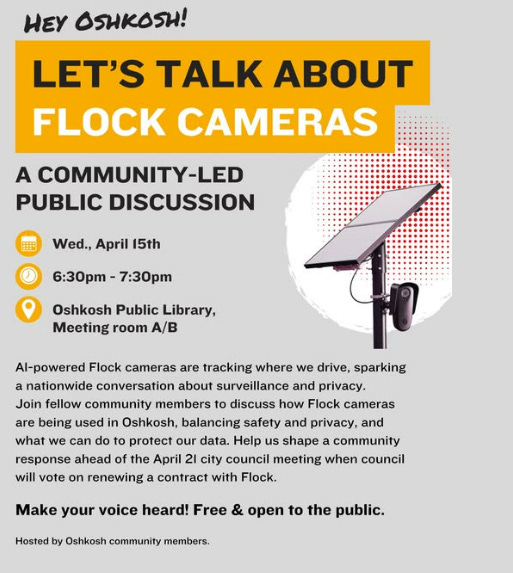
April 15 — A community-organized public discussion on Flock drew approximately 70 residents. The room was largely opposed. This was not a city event; it was a parallel public record being created by residents, on residents’ own terms — and crucially, before the renewal vote rather than after.
April 19 — I published the guest view in the Oshkosh Northwestern: “I Know What a Pattern-of-Life System Looks Like — Oshkosh May Buy One.”
The op-ed did one specific thing. It placed the U.S. Army Intelligence Analysis Manual’s definition of pattern-of-life intelligence collection — persistent location collection, baseline establishment, deviation detection, and predictive analysis — into the public record next to Flock Nova, the company’s law-enforcement-only link-analysis and aggregation platform. That juxtaposition is the technical spine of the case.
The point of cataloging all of this together is straightforward. The case against the renewal was being made in print, with named bylines, in the city’s paper of record, by multiple residents, for two full weeks before the vote. Council members who voted yes on April 21 were not voting in the absence of public information. They were voting against it.
April 21 — The Renewal Vote
The meeting opened with more than two hours of public comment from over two dozen speakers. A majority opposed renewal. A minority supported it.
The voices in opposition included a national security professional speaking as a veteran (myself), residents framing the issue as one of unregulated AI surveillance and the failure of governments to keep pace with the technology, and others speaking on Fourth Amendment grounds, data-sharing concerns, and the documented misuse cases in Menasha and Milwaukee where officers had been charged for tracking people through Flock cameras.
The voices in support framed the cameras as essential to apprehending fugitives and solving crimes, with one speaker specifically arguing that removing the system would let dangerous individuals operate undetected in Oshkosh.
A handful of attendees walked out of the chambers during the Council’s deliberations.
In the middle of the discussion, Councilman Brad Spanbauer asked the Flock representatives a specific, binary question about the platform’s capabilities:
The Flock representatives in the room included Chris Castaldo, the company’s Chief Information Security Officer, and Kristen McLeod. The answer they gave Spanbauer was no.
Following that answer, the Council voted 5–2 to renew the contract, having amended it from two years to one before the vote.
Yes: Mugerauer, Buelow, Spanbauer, Stephenson, Esslinger
No: Amos, Lefeber
Two of the yes votes — Spanbauer and Stephenson — had supported the March 31 delay specifically so the Council could get clearer answers about Flock’s capabilities. They voted yes on April 21 because, based on the answers they received that night, they believed they had them. The April 22 rescission would prove otherwise.
The full meeting is below. Three things to watch: the public-comment portion, where over two dozen residents spoke and a handful walked out of chambers during deliberations (you get to hear my scream LIAR a 2:30:20); the exchange in which Councilman Spanbauer asks the Flock representatives whether the system creates a heat map of a vehicle's movement, and they answer no; and the 5–2 roll call.
April 22 — The Rescission
By the morning of April 22, members of the Oshkosh Police Department had brought Chief Smith information that conflicted with what Flock had told the Council the night before. Smith stated that he visually confirmed it himself: the Flock system does, in fact, contain a heat-map feature of the kind Spanbauer had specifically asked about. Smith notified City Manager Rebecca Grill, and a special session was called the same day.
At that special session, Smith told the Council, on the record, that he could no longer recommend Flock — citing the misrepresentation made specifically in response to a question asked by a council member.
Council members who had voted yes the night before reversed their positions in turn, several apologizing publicly:
Joe Stephenson said he could not make decisions about a system’s capabilities if the vendor lied to him.
Karl Buelow, the Deputy Mayor, said he was deeply embarrassed and apologized for his vote.
Paul Esslinger and Mayor Matt Mugerauer maintained they had voted in good faith based on the information available the night before, but voted to rescind based on the new information.
The vote to rescind Resolution 26-164 was unanimous, 7–0.
In the days following, Assistant Chief Brian Schuldes confirmed that all 26 Flock cameras would be powered down, bagged, and removed by the company under contract terms, and that all internal accounts had been deactivated except for the system administrator. All external agency access had been revoked. Smith said the cameras were expected to be down by the start of summer.
The full special session is below. Watch Chief Smith's statement for the moment he tells the council, on the record, that he visually confirmed the heat-map feature that morning and can no longer recommend Flock. Watch the yes-voters from the night before reverse their positions, one by one. The 7–0 rescission follows.
April 23 — Flock’s Response
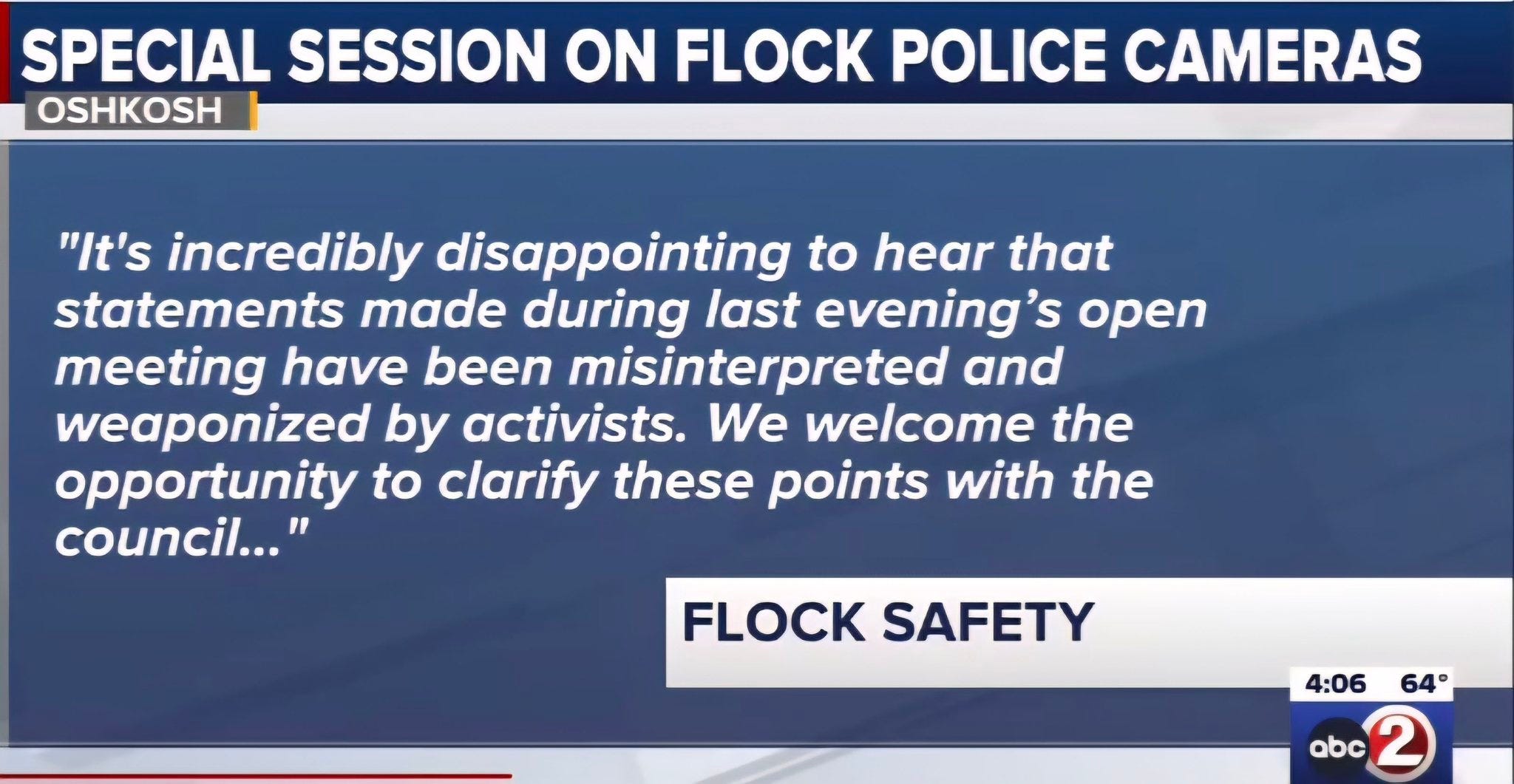
Flock Safety issued a written statement to FOX 11 and WBAY characterizing the events in Oshkosh as a small misconception, and described community members who raised concerns as activists who had weaponized the company’s words. The same statement said the company welcomed the opportunity to clarify.
I took them up on it.
April 24 — The Public Questions
I submitted five questions in writing to Flock’s communications contact via email and publicly, with a deadline of 5 p.m. CT on April 24, 2026:
The full name, title, and office location of each Flock employee who spoke or answered questions at the April 21 Oshkosh Common Council meeting. (No longer required - I have their linked-ins tagged above and here: Chris Castaldo and Kristen McLeod.
The basis for the on the record claim that Flock does not offer a product comparable to Palantir, given that Flock Nova integrates ALPR data with third-party data broker records and produces person-centric investigative leads — as described by Flock employees in internal audio published by 404 Media in May 2025.
Which of the four components of pattern-of-life analysis, as defined by the U.S. Army Intelligence Analysis Manual, Flock contends its technology does not provide.
Whether Flock considers published research and public comment by a resident with professional subject-matter background to fall within the definition of weaponization the company used in its April 22 statement — and if so, what distinguishes weaponization from good-faith subject-matter critique.
Which specific statements from the April 21 meeting Flock believes were misinterpreted, and by whom.
As of 24 September — Flock has not responded.
PART II — THE REPLICABLE PLAYBOOK
The Operating Theory in One Sentence
A vendor that has misrepresented its capabilities to one council can be made to repeat that misrepresentation in front of yours — on the record — if you ask the right question.
Once the misrepresentation is on the record, your job is no longer to convince the council that Flock is bad. Your job becomes documenting the gap between what was said in the room and what is true on paper.
Step 1 — Read the contract before you read the marketing
File an open records request for:
Every executed contract, amendment, and statement of work between your city and Flock Safety.
Every invoice, with line-item descriptions and SKUs.
Every memorandum of understanding or data-sharing agreement.
The current ALPR usage policy and every prior version, dated.
The audit log of every Flock search by your local department, with username, timestamp, query, search reason, and result count.
Time gated requests to emails containing the verbiage “ALPR”, Flock, Axon, etc.
A template request, adaptable to most state public-records statutes, is in Part IV.
The most important question this step answers: what products is your city actually paying for? Flock sells more than cameras. Nova, FlockOS, Investigations Manager, Raven, FreeForm, Vehicle Fingerprint. The original vote in many cities authorized cameras. Most of the rest was added quietly.
Step 2 — Identify the gap between what they sell and what they say in public
Flock’s sales materials, conference talks, and engineering team have all said things on the record that the company’s government-facing representatives carefully do not repeat in council chambers. The most important sources for finding this gap:
404 Media (Joseph Cox, Jason Koebler, Dhruv Mehrotra) — internal Flock audio and Nova reporting, May 2025 onward. The foundational piece is “License Plate Reader Company Flock Is Building a Massive People Lookup Tool, Leak Shows” (May 14, 2025).
IPVM — surveillance-industry trade reporting on Flock product capabilities, security failures, and component sourcing.
EFF — Matthew Guariglia’s analysis, including “Traffic Violation! License Plate Reader Mission Creep Is Already Here” (March 26, 2026) and “Flock Safety’s Feature Updates Cannot Make Automated License Plate Readers Safe” (June 2025).
DeFlock.me — community-maintained map of Flock camera locations; useful to compare to your city’s officially disclosed deployment.
Wyden / Krishnamoorthi FTC letter, November 3, 2025 — the congressional record establishing federal scrutiny of Flock’s cybersecurity practices, including the company’s failure to require multi-factor authentication and documented Russian-cybercrime-forum sales of Flock logins. (Press release here.)
Step 3 — Write the argument down before you say it out loud
Before you ever stand at a podium, write your argument down.
The intent of my Oshkosh op-ed did exactly one thing: it placed the U.S. Army’s pattern-of-life definition next to Flock Nova’s documented capabilities. That juxtaposition is reusable. Most ALPR vendors will fail the same test.
Step 4 — Organize the room
A community-organized town hall — separate from the council meeting — produces three assets at once:
A head count of opposition that exists outside official channels.
A list of residents willing to speak during public comment.
A parallel public record (photos, video, attendance) that contradicts any later claim that “the community wants this.”
A durable contact list. Set a clipboard at the door. The sign-in sheet is the asset most often forgotten in the moment, and the one most missed afterwards. A simple opt-in form — name, email, and a single check-box indicating willingness to be contacted about future Flock-related advocacy — is enough. That list is the essence of grass roots organizing that fights the next vote, the next records request battle, and the next neighboring city's renewal.
Aim for it to happen before the council meeting where the contract is on the agenda. Two weeks before, if possible.
Step 5 — Ask the one question that matters
There are two questions that belong on the record at every Flock vote in every city. The first establishes the technical and legal framework. The second is the one that, in Oshkosh, broke the contract overnight.
QUESTION ONE — THE FRAMEWORK QUESTION
“Does any Flock product — including Flock Nova, FlockOS, or any feature accessible through the National Lookup network — satisfy the U.S. Army Intelligence Analysis Manual’s four-component definition of pattern-of-life intelligence collection: persistent location collection, baseline establishment, deviation detection, and predictive analysis? Yes or no.”
Why it works:
It uses Flock’s own denial framing against them. Flock representatives consistently deny pattern-of-life. This question forces them to defend that denial against an external, authoritative definition rather than their own marketing copy.
It pins them to a definition they cannot rewrite.
It demands a binary answer; “it depends” is itself a useful answer.
It closes the network-level escape hatch. Even if your local department does not subscribe to Nova, other agencies on Flock’s National Lookup network do and they can query your local camera data.
QUESTION TWO — THE FEATURE QUESTION
“Just to be clear, does the Flock system create a heat map of a vehicle’s movement using multiple aggregated images for a specific searched vehicle? Yes or no?”
This is the question Councilman Brad Spanbauer asked in Oshkosh on April 21. The Flock representative’s answer was no. Less than 24 hours later, the Chief of Police publicly confirmed that the system does in fact contain that exact feature visible on screen, with the company’s own UI label.
Why it works — and why every city should ask it verbatim:
It is about a feature, not a concept. The Flock platform either has a heat-map feature or it does not. There is no room for interpretation.
It is binary by construction. The witness can answer yes, no, or refuse to answer and any of those answers produces a useful record.
It is verifiable in real time. Your police chief, IT director, or any other employee with credentials can pull up the platform after the meeting and check. Oshkosh’s chief did exactly that the next morning.
It cannot be “misheard” without the misunderstanding itself becoming the story. Flock’s defense after Oshkosh was that its representative had heard a different question and answered that one. That is itself a form of misrepresentation and one a council can act on.
Ask both questions. Question One puts the legal and technical stakes on the record. Question Two converts those stakes into a binary, falsifiable claim that someone in the room can verify the next morning. Either question, alone, can win. Together, they are very difficult to escape.
If the company answers no to Question Two, the chief or the IT director needs to be asked, on the record, to verify the answer within 24 hours. That single follow-up is what turned the Oshkosh vote.
Step 6 — Make the misrepresentation the story
After the vote — even if you lose the vote — the story is no longer “should we have Flock?” The story becomes: “Did the vendor misrepresent its capabilities to our elected officials?”
That is a story your local police chief, city attorney, and individual council members will all be required to address. It is also a story your local press will cover, because it is much more concrete than a privacy debate.
In Oshkosh, the chief addressed it within 24 hours. Your timeline may be longer. The pressure does not need to be loud; it needs to be documented and consitent.
Step 7 — Don’t stop after the vote
Whatever the outcome, the fight does not end at the meeting:
Submit formal written questions to Flock’s communications team with a deadline.
Whether they respond or not, publish the questions and the response (or absence of one).
Monitor neighboring cities’ contracts. Flock’s misrepresentation in your city is directly relevant to renewals everywhere else. Write to those councils with your documentation.
File follow up records requests for internal communications between your local department and Flock immediately surrounding the meeting. The most important documents in this fight are usually the ones written between officials after the public testimony.
PART III — WHAT FLOCK WILL SAY (AND HOW TO ANSWER)
These are the rebuttals you will hear, in roughly the order Flock tends to deploy them. Each one has a documented contradiction. Have the contradiction ready before you walk into the room.
Flock’s claim: “We don’t enable pattern-of-life analysis.”
Where it falls apart: The U.S. Army Intelligence Analysis Manual defines pattern-of-life as persistent location collection, baseline establishment, deviation detection, and predictive analysis. Flock Nova performs link analysis and aggregation across networked ALPR data; the May 2025 404 Media reporting documents internal Flock employees describing person centric investigative outputs.
Flock’s claim: “Our system does not create a heat map of a vehicle’s movement.”
Where it falls apart: The Flock platform contains a feature labeled “heat map” in its own user interface that shows aggregated point-in-time captures of a vehicle over a defined retention period (Flock’s own description: 30 days). Asked under oath or before a council, this answer is verifiable in real time by anyone with a credentialed login. The Oshkosh Chief of Police did exactly that on April 22, 2026, and rescission followed within hours.
Flock’s claim: “The city owns 100% of the data.”
Where it falls apart: Flock representatives have separately acknowledged that a portion of image data is used to train the company’s AI. If the city truly owns all of it, the company would not have access to any of it for that purpose.
Flock’s claim: “We don’t offer a product comparable to Palantir.”
Where it falls apart: Flock Nova integrates ALPR data with third-party data broker records to produce person-centric investigative leads, the functional definition of the platform Flock claims it is not.
Flock’s claim: “Our system has produced higher clearance rates.”
Where it falls apart: Ask for the math. Pre-Flock vs. post-Flock, by crime category, with controls for trend and other variables. In most cities, the answer is either unavailable or does not survive scrutiny.
Flock’s claim: “The community wants this.”
Where it falls apart: File a public-records request for all constituent communications to council, the mayor, the city manager, and the chief regarding Flock and ALPRs over the past 12 months. Under Schill v. Wisconsin Rapids School District (and most analogous state-law doctrines), communications about government business sent to officials’ personal accounts are also public records. The actual record of constituent contact will speak and trust they are afraid of the documented record your email creates.
Flock’s claim: “It was a small misconception.” / “A minor nuance.”
Where it falls apart: A police chief publicly confirming that information conflicted with what the vendor told the council, less than 24 hours after the vote, is not a small misconception. The 7–0 reversal that followed is not a minor nuance.
Flock’s claim: “Our representative misheard the question.”
Where it falls apart: A vendor whose representatives mishear binary, feature-specific yes-or-no questions from elected officials in a public meeting is one a council should not contract with. The remedy is the same as for an answered question: rescission.
PART IV — TEMPLATES
A. Public Comment Email to Council
Subject: Say No to Flock
Dear Council,
I am writing to ask that you vote no on renewing the contract with Flock. I oppose the use of Flock cameras due to the potential for abuse, the erosion of personal privacy, and serious concerns about data security.
This technology is being adopted without proper safeguards. There are no meaningful protections ensuring how data is stored, who can access it, or how misuse can be prevented. Systems like this expand surveillance infrastructure without proven effectiveness, while exposing the city to legal, financial, and ethical risks. The potential harms clearly outweigh any speculative benefit.
Flock cameras are not the right investment for [CITY]. I do not feel safe with them on our streets. I strongly object to my tax dollars being used for mass surveillance, and I urge the council to look into alternative solutions that are transparent, accountable, and community focused.
Sincerely, A Concerned Citizen
B. Open Records Request — Contracts and Audit Log
To: [city records custodian] Subject: Open Records Request — Flock Safety Contracts and Records
Dear Records Custodian,
Pursuant to [STATE PUBLIC RECORDS LAW — for Wisconsin, Wis. Stat. §§ 19.31 through 19.39], I respectfully request copies of the following records:
All fully executed contracts, amendments, addenda, statements of work, order forms, and exhibits between [CITY] and Flock Group Inc. (d/b/a Flock Safety) from [START DATE] to the present.
All invoices paid to Flock Group Inc. during the same period, including any itemized line descriptions, SKUs, or product codes.
All documents describing Flock products or services currently active in the city’s deployment, including but not limited to Flock Nova, FlockOS, Flock Investigations Manager, Flock Raven, Flock FreeForm, Vehicle Fingerprint, Drone as First Responder, and any third-party integrations.
All data-sharing agreements, memoranda of understanding, or network-access agreements between [CITY] (or [LOCAL POLICE DEPARTMENT]) and any other agency concerning Flock data.
The complete audit log of all searches conducted in the Flock system by [DEPARTMENT] personnel or any authorized external user, from [START DATE] to the date of this request.
I am willing to pay reasonable copying fees up to $50; please notify me in advance if fees will exceed that amount. Electronic copies are preferred.
If any portion of this request is denied, please cite the specific statutory authority for each redaction or withholding. If the records are voluminous, I request production on a rolling basis.
Sincerely, [Name / Outlet / Contact]
C. Open Records Request — Constituent Communications
Use this when a vendor or city official claims “the community wants this.” This request produces the actual record of constituent contact regarding Flock — including communications sent to officials’ personal accounts about government business, which are public records under Wisconsin’s Schill v. Wisconsin Rapids School District doctrine and most analogous state-law doctrines (confirm yours before filing). The output is a count, by date and sender, that either confirms the claim or contradicts it.
To: [city records custodian] Cc: [city clerk; council members’ offices, if filed simultaneously] Subject: Open Records Request — Constituent Communications Regarding Flock / ALPRs
Dear Records Custodian,
Pursuant to [STATE PUBLIC RECORDS LAW — for Wisconsin, Wis. Stat. §§ 19.31 through 19.39], I respectfully request copies of the following records, covering the period from [DATE — typically 12 months prior] through the date of this request:
All emails sent to or received by any current or former member of the [CITY] Common Council, the Mayor, the City Manager, the Chief of Police, and any deputy or assistant chiefs, that contain any of the following terms or that otherwise concern the subject matter below: “Flock,” “Flock Safety,” “ALPR,” “automated license plate reader,” “license plate reader,” “LPR,” “Nova,” “FlockOS,” “FreeForm,” “Vehicle Fingerprint,” “Raven,” and the resolution numbers and contract identifiers associated with the city’s Flock agreement(s).
All paper correspondence, including letters and notes, addressed to or written by the officials listed above on the same subject matter.
All voicemails left for any of the officials listed above on the same subject matter, and any transcriptions or summaries thereof.
All messages, comments, replies, mentions, tags, and direct messages received by the officials listed above on official social media accounts (including Facebook, X / Twitter, Instagram, LinkedIn, Bluesky, Threads, and any other platform on which an official account is maintained), and any official city or department accounts, on the same subject matter.
All comments, messages, or correspondence submitted through the [CITY] official website’s contact form, public comment portal, or any analogous public-facing intake mechanism.
All text messages and other electronic communications, including those sent or received on personal devices and personal accounts, by any of the officials listed above, that concern city business related to Flock or ALPR technology. Under Schill v. Wisconsin Rapids School District, 327 Wis. 2d 572 (2010), records of government business retained on personal accounts or devices are public records subject to disclosure. [For requesters in other states: cite your state’s analogous doctrine here, or strike the citation and rely on the general public-records statute.]
Any logs, intake records, or summaries maintained by city staff that catalog public contact regarding Flock or ALPRs, including any spreadsheets or trackers used to count, sort, or categorize such contacts.
For each responsive record, please include any associated metadata available — sender, recipient, date, time, and the channel through which it was received — to the extent these are normally maintained.
Electronic copies are preferred. I am willing to pay reasonable copying fees up to $50; please notify me in advance if fees will exceed that amount.
If any portion of this request is denied, please cite the specific statutory authority for each redaction or withholding, as required by [Wis. Stat. § 19.35(4)(b) — adapt to your state]. Personal contact information of private constituents (home addresses, phone numbers, email addresses) may be redacted; the substance of the communications and the dates may not.
If the records are voluminous, I request production on a rolling basis, beginning with the most recent records.
I do not need to state a reason for this request, but I am providing one as a courtesy: I am [a journalist / a resident / a researcher] examining the public record of constituent input on the [CITY]’s pending or recent decision regarding Flock Safety, in connection with [BRIEF PURPOSE].
Sincerely, [Name / Outlet / Contact]
Strategic note. When the response arrives, sort by date and by sender. Two metrics matter most: the ratio of opposition to support, and the trend over the period. If the city renewed Flock while constituent communications ran 5-to-1 against, that is a story. If contacts in opposition spiked in the weeks before a vote and were ignored, that is a different story. Both are worth publishing.
D. Three-Minute Public Comment Outline
Identify yourself. Name, neighborhood. One sentence on relevant background if you have it (technical, legal, parent, business owner, veteran).
Name the misrepresentation. “On [date], Flock representatives told this council [specific statement]. That statement is contradicted by [specific source, with citation].”
Ask the question. Read it from the page. “Does any Flock product satisfy the U.S. Army Intelligence Analysis Manual’s four-component definition of pattern-of-life intelligence collection. Yes or no.”
State the consequence. “If the answer is no, the company is on record contradicting its own product documentation. If the answer is yes, the company has misrepresented its capabilities to this council in prior testimony. I am asking that the renewal be deferred until that question is answered, in writing, by Flock’s leadership.”
Sit down.
PART V — LESSONS LEARNED
Speed matters. Twenty-two days from the deferral to the rescission. The window in which a council is willing to revisit a vote is short. Do not let it close.
The single most important question beat the fifty-page brief. A surgical question, asked by a sitting council member, did more in five seconds than weeks of advocacy materials.
The chief’s confirmation was significant. Without an official inside the system willing to publicly state that the vendor misrepresented its capabilities, this is meaningfully harder.
Document the network level argument early. Flock’s representatives will retreat to “but our local config doesn’t have Nova.” The National Lookup network argument closes that exit before they can take it.
Separate threads stay separate. Surveillance concerns, foreign-influence concerns, civil-liberties concerns, and cybersecurity concerns are each individually strong. Stacking them muddies all of them. Pick the one your city’s specific contract makes strongest, and lead with it.
Build the contact list at the door. Approximately seventy people came to the April 15 community discussion. They left without a way to stay in touch with one another. We recognized the gap only afterward. The fix is a clipboard. At any community organized event, set out a simple opt-in sign-in sheet at the entrance: name, email, and a single check box indicating willingness to be contacted about future Flock related advocacy. The list you build that way is the durable coalition that fights the next vote, the next records-request battle, and the next neighboring city's renewal. The room you fill once is a moment. The list you keep is infrastructure.
There is a personal cost. Putting your name on this work makes you a named target, for the company, for its supporters in your city, and online. Think about your operational security before, not after. Which leads us to part VI.
PART VI — PERSONAL OPSEC: A SELF-DEFENSE MANUAL
Once you put your name on a Flock fight, you become a target. For the company. For police aligned online communities. For opportunistic harassment networks that read local paper bylines and council meeting minutes as targeting lists. This is true even when you win.
What follows is a tiered self-defense manual. Most of it is free, the rest is cheap. If you are about to put your name on a Flock fight in your city, start working through this now.
Tier 1 — Do this today (free, 1–2 hours)
Two-factor authentication on every account. Use an authenticator app (Authy, Aegis, the built-in iOS / Android one) or a hardware key. Do not use SMS for 2FA. SMS is vulnerable to SIM swap attacks.
Set a port-out PIN with your wireless carrier. Call AT&T, Verizon, T-Mobile, or whoever — and ask to add a port-out PIN to your account. This stops attackers from transferring your number to a SIM card they control.
Audit your social media privacy settings. Set Facebook, Instagram, LinkedIn, X, and any other accounts to private. Strip out birthday, hometown, schools, employer, and family connections. Untag yourself from old photos that show your home, your vehicle, or daily-routine locations.
Strip GPS metadata from any photos you have ever posted publicly. Most phones embed location coordinates in photo files. A past Instagram post of your front porch is functionally an address.
Tier 2 — Do this this week (free or cheap)
Start removing yourself from data brokers. The canonical free DIY guide is Yael Grauer’s Big Ass Data Broker Opt-Out List — the same list cited by Wired, the New York Times, Consumer Reports, and CISA’s High-Risk Community Protection Planning page. Work through 10–20 sites per week. Then re-run every 3–6 months — brokers re-acquire your data over time.
If DIY is too time-intensive, use a paid service. Recommended:
Optery has a real free tier (exposure scan with screenshots) and paid tiers from $3.99/month. PCMag Editors’ Choice multiple years running.
EasyOptOuts is roughly $20/year and is what the Privacy Guides project and Consumer Reports rate as best value.
DeleteMe ($8.71+/month) and Incogni are the better-known names; both work, both pricier.
Switch sensitive communications. Use Signal for messaging. Use Proton Mail or Tutanota for sensitive email. Use a VPN — Orbot.
Set up a password manager. Bitwarden is free and open-source. 1Password is paid but excellent. Use unique long passwords on every account; let the manager generate them.
Tier 3 — Do this this month (free, but takes paperwork)
Apply to your state’s Address Confidentiality Program. This is the single most important step for anyone whose home address is at risk. ACPs assign you a legal substitute address you can use for voter registration, driver’s license, court documents, school enrollment, and most government facing records. Mail to the substitute address gets forwarded to your real one for free. Roughly forty states administer such a program.
Wisconsin: Safe at Home. Administered by the Wisconsin DOJ Office of Crime Victim Services. Phone (608) 266-6613, toll-free (800) 446-6564. Email safeathome@doj.state.wi.us. Website: SafeAtHomeWI.gov. Eligibility includes victims of (or those who fear) domestic abuse, sexual assault, stalking, trafficking, or other documented physical-safety threats. Wisconsin requires documentation; the program intake walks you through what counts.
Other states: find your state’s ACP through the Minnesota Secretary of State’s national directory at sos.mn.gov/safe-at-home/resources-for-safety/other-states-with-programs-like-safe-at-home/.
Get a hardware security key. A YubiKey is $25–$50 and converts your most important accounts: email, password manager, social media, cloud storage into accounts an attacker physically cannot access without holding the key in their hand.
Pre-build your incident response kit. Bookmark these resources now, while you are not in crisis:
PEN America Online Harassment Field Manual — the comprehensive playbook covering preparation, response, documentation, and law-enforcement engagement.
Freedom of the Press Foundation Digital Security Guides — current, journalist focused but applicable to anyone.
CUNY Newmark “Dealing with Doxxing” Guide — concise, practical, free.
Consumer Reports Security Planner — interactive checklist tailored to your specific situation.
Tier 4 — If you are being doxxed or harassed right now
Immediate physical danger: call 911.
Document first, react second. Screenshot every threat, every post, every comment: including the URL, the username, the timestamp, and the platform. Documentation is what platforms, employers, lawyers, and law enforcement will require, and it cannot be created retroactively.
Report to platforms through their public abuse-reporting mechanisms. Slow but the paper trail matters.
For credible online threats: file a report with the FBI’s Internet Crime Complaint Center at ic3.gov.
Wisconsin residents who fear for their safety: contact Safe at Home immediately at (608) 266-6613 or (800) 446-6564. Out-of-state: contact your state’s ACP through the Minnesota directory linked above.
Journalists can contact the Journalist Safety Urgent Care Helpline a collaboration of PEN America, the Committee to Protect Journalists, IWMF, Freedom of the Press Foundation, the Reporters Committee for Freedom of the Press, and Aegis Safety Alliance. Current intake at pen.org. The helpline provides safety consultations covering digital, physical, legal, and psychosocial concerns.
Tell your editor, your lawyer, your family, and at least one trusted person in your community. Isolation is what doxxing campaigns are designed to produce.
PART VII — RESOURCES
Primary documentation:
U.S. Army Intelligence Analysis Manual — the formal title is ATP 2-33.4, Intelligence Analysis (Army Techniques Publication 2-33.4; current edition May 2025, Change 1; pattern-of-life is treated at paragraphs 5-120 and 5-121). The publicly available text linked here is the August 2014 (FOUO) edition; the substantive pattern-of-life framework has remained consistent through the 2020 and 2025 revisions.
404 Media — Cox / Koebler / Mehrotra reporting on Flock Nova, beginning May 2025. The foundational piece is “License Plate Reader Company Flock Is Building a Massive People Lookup Tool, Leak Shows” (May 14, 2025). Outlet at 404media.co.
Electronic Frontier Foundation — Matthew Guariglia’s policy analysis on ALPR networks, including “Traffic Violation! License Plate Reader Mission Creep Is Already Here” (March 26, 2026) and “Flock Safety’s Feature Updates Cannot Make Automated License Plate Readers Safe” (June 2025).
IPVM — surveillance-industry trade reporting on Flock product capabilities, security failures, and component sourcing.
Wyden / Krishnamoorthi letter to the FTC on Flock, November 3, 2025. Press release here.
DeFlock.me a community-maintained Flock camera location map.
Independent journalism and analysis:
Benn Jordan — “We Hacked Flock Safety Cameras in under 30 Seconds” (November 2025), the YouTube investigation that, alongside Jon “GainSec” Gaines’s research, surfaced the Condor PTZ exposure later confirmed by 404 Media.
Jessica Burbank — “You’re Being Watched: The Company Behind America’s Mass Surveillance Takeover” (free, 2025). See also her parallel-city playbook interview, “How To Get Flock Cameras Out Of Your City: The Eugene Playbook”, with Rob Sheldon of Eyes Off Eugene.
Mehlia Hauxwell — April 19, 2026 op-ed, Oshkosh Northwestern — “I Know What a Pattern-of-Life System Looks Like — Oshkosh May Buy One”
Legal and procedural:
Wisconsin Public Records Law — Wis. Stat. §§ 19.31–19.39. Full text from the Wisconsin Freedom of Information Council; official statute on the Wisconsin Legislature site; Wisconsin DOJ Public Records Law Compliance Guide (2025).
Schill v. Wisconsin Rapids School District, 2010 WI 86, 327 Wis. 2d 572 — establishes the connection-to-government-function test for what constitutes a public record under Wisconsin law. Communications about government business are public records regardless of whether they reside on a government or a personal account.
A note on the author
I am a resident of Oshkosh, Wisconsin, with a professional background in intelligence analysis. I am not affiliated with any organization, advocacy group, or political party. The work documented here was undertaken as a private citizen and an independent journalist, and is published here on substack.
This is a living document. Corrections, additions, and contributions from organizers in other cities are welcome.
I want to hear from you — what questions, comments, concerns, or story tips do you have for me? See a headline in the news & think “that can’t be real…is it?” — tell me. This is a community where we learn and grow together.
The Last 24 Hours is my refusal to stay quiet and your refusal to look away. If you believe an informed citizenry is the last line of defense, then subscribe, share, and make some noise. You found this. Now make sure someone else does too.
This is such amazing information. A “How-to” to get flock out of our country, city by city. Amazing work, Mehlia.